
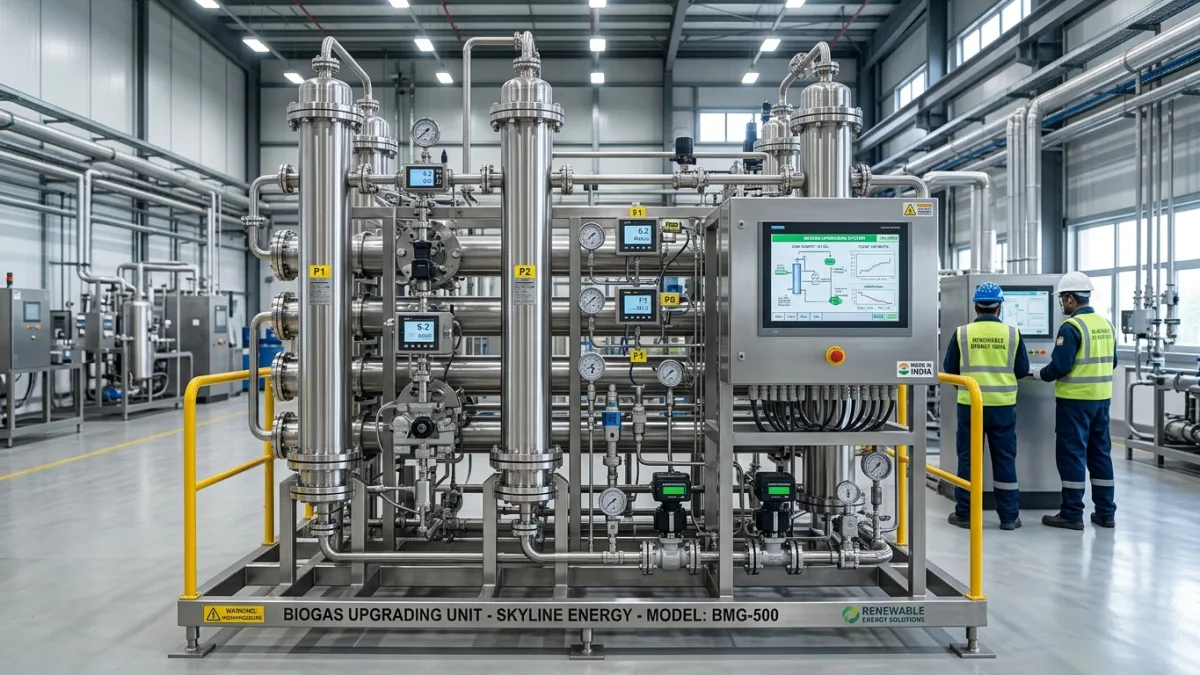
The conversion of raw, moisture-laden biogas into commercial Compressed Biogas (CBG) requires specialized separation technology. Because raw biogas contains 35–45% carbon dioxide and trace corrosive gases, the upgrading skid represents the technical heart of any Bio-CNG refinery.
Amvats CBG is a specialized CBG and Bio-CNG business vertical under AMVATS ENGINEERING & TECHNOLOGIES, engineering advanced gas purification and separation packages for commercial plants.
1. Why Upgrading is Essential
Raw biogas cannot be directly compressed into vehicles. The presence of CO2 dramatically reduces calorific density, while moisture and H2S cause rapid acid formation that damages compressors, valves, and vehicular fuel injection systems. Upgrading purifies the gas to meet the rigorous IS 16087:2016 specification:
- Methane (CH4) ≥ 90.0% (typically targeted at ≥ 96.0%)
- Carbon Dioxide (CO2) + Nitrogen (N2) ≤ 4.0%
- Hydrogen Sulfide (H2S) ≤ 20 mg/m3 (approx. 15 ppm)
- Moisture content ≤ 5 mg/m3
2. Comparison of Upgrading Technologies
A. Polymeric Membrane Separation (Industry Preferred)
Modern commercial CBG plants predominantly favor multi-stage polymeric hollow-fiber membranes. This process relies on differential permeability across microscopic polymer pores:
- Mechanism: Smaller CO2, H2O, and H2S molecules permeate through the membrane fiber wall quickly, while larger CH4 molecules remain in the high-pressure retentate stream.
- Advantages: Modular skid footprint, low parasitic power consumption, rapid start-up/shut-down, and methane recovery rates above 99% with multi-stage recycling loops.
B. Pressure Swing Adsorption (PSA / VPSA)
PSA systems utilize molecular sieves (carbon molecular sieves or zeolites) packed into vertical adsorption columns:
- Mechanism: Under elevated pressure, the adsorbent selectively captures CO2 molecules while allowing CH4 to pass. Depressurizing the bed releases the adsorbed CO2, regenerating the media.
- Considerations: Requires rigorous gas pre-drying and fine dust filtering. Well suited for steady, predictable gas flows.
C. Pressurized Water Scrubbing (PWS)
PWS leverages the physical reality that carbon dioxide is significantly more soluble in water than methane at elevated pressures:
- Mechanism: Biogas is pumped upwards through a vertical packed column while pressurized chilled water flows downward. CO2 dissolves into the water stream, discharging pure methane at the column head.
- Considerations: Requires substantial continuous water circulation, pumping energy, and anti-foaming chemical monitoring.
Explore our engineering methodology in Biogas Upgradation & Gas Purification Solutions.
3. Integrated Pre-Treatment: Desulfurization & Dehumidification
Regardless of which bulk CO2 separation technology is deployed, the upstream protection train is critical:
- Biological Desulfurization: Bio-trickling filters consume sulfur compounds without heavy chemical expenditures.
- Chilling & Condensation: Gas chillers lower temperature to 4°C, condensing out free moisture.
- Activated Carbon Polishing: Guard beds remove any remaining volatile organic compounds and siloxanes.
Conclusion
Selecting the right biogas upgrading package is vital for maximizing methane recovery and project profitability. For process modeling and technology selection, contact Amvats CBG.