
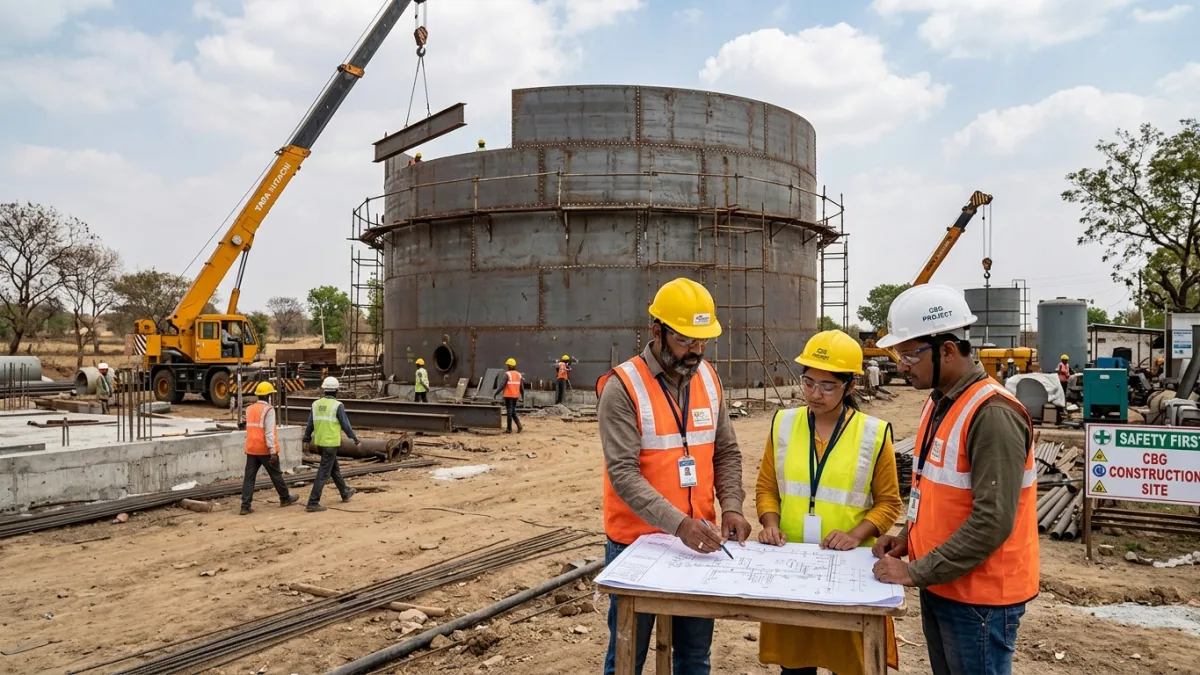
Establishing a commercial Compressed Biogas (CBG) plant in India involves substantial multidisciplinary engineering, land procurement, and precision equipment procurement. Understanding the realistic financial parameters—without relying on unverified estimates—is essential for any project developer or institutional investor.
Amvats CBG, a specialized business vertical of AMVATS ENGINEERING & TECHNOLOGIES, assists commercial developers with bankable Detailed Project Reports (DPR), equipment sizing, and lifecycle economic modeling.
1. Typical Capital Expenditure (CAPEX) Dynamics
The total project outlay for a commercial Bio-CNG plant depends predominantly on rated daily gas production capacity (e.g., 2 TPD, 5 TPD, 10 TPD, or 20 TPD of finished CBG). Key capital components include:
- Civil Construction & Digester Tanks: Deep foundational civil works, CSTR digester tanks with epoxy or glass-fused-to-steel liners, feedstock storage sheds, and lagoon retention ponds.
- Upgradation & Purification Skids: High-efficiency biological desulfurization, moisture chillers, and 3-stage membrane or VPSA gas separation packages.
- Gas Compression & Cascade Systems: Heavy-duty 250 bar non-lubricated compressors, automated cascade cylinder banks, and mobile tube trailers.
- Digestate Separation & FOM Packaging: Decanter centrifuges, rotary drum dryers, automated bagging machines, and solar drying yards.
- Electrical, SCADA & Grid Infrastructure: Dedicated 11kV/33kV substations, silent backup gensets, PLC control systems, and online gas chromatographs.
2. Plant Scale vs. Capital Intensity
Commercial CBG projects benefit strongly from economies of scale. While a smaller 2 TPD facility requires dedicated foundational civil works and control infrastructure, scaling to 5 TPD or 10 TPD significantly reduces the capital expenditure required per kilogram of gas produced.
You can model initial production and revenue estimates using our interactive Bio-CNG Yield & Viability Calculator.
3. Operating Expenditure (OPEX) Factors
Long-term profitability depends on managing daily operational costs:
- Feedstock Procurement & Logistics: Raw material pricing, seasonal baling, transport radius (ideally within 25–40 km of the plant), and storage management to prevent biodegradation.
- Electrical Power Consumption: Running agitators, high-pressure pumps, compressors, and cooling loops. Many plants integrate captive biogas-to-power generators or rooftop solar to curb utility grid expenses.
- Chemical Consumables & Media: Activated carbon for H2S polishing, defoamers, and biological nutrients.
- Staffing & Plant Maintenance: Skilled chemical process operators, mechanical technicians, and logistics coordinators.
4. Government Subsidies & Financial Incentives
Under the Central Financial Assistance (CFA) by the Ministry of New and Renewable Energy (MNRE), eligible Bio-CNG projects may qualify for capital subsidies per 4,800 kg/day of CBG generated from biomass. Furthermore, state-specific industrial policies—such as the Bihar Bio-fuels Promotion Policy—offer capital subsidies, stamp duty exemptions, and electricity duty waivers to accelerate clean energy deployment.
Conclusion
Accurate feasibility assessment and conservative feedstock yield testing are crucial before breaking ground. Explore our professional DPR & Technical Feasibility Studies to build a bankable project framework.