
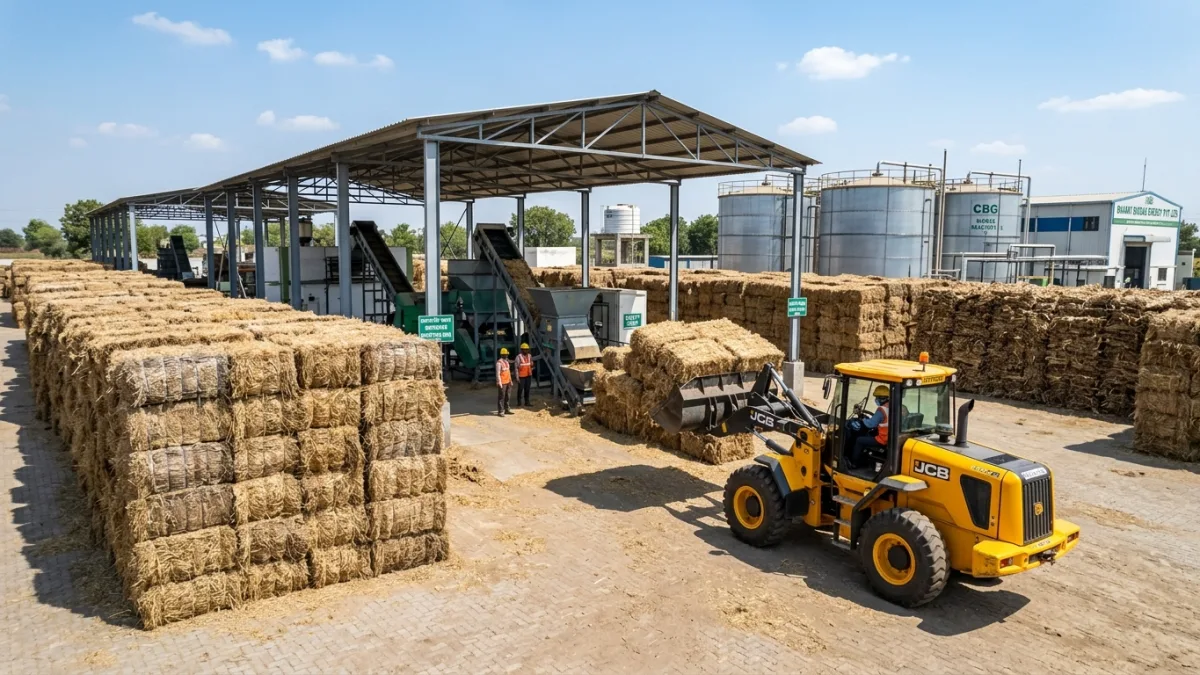
The commercial and operational viability of an industrial Compressed Biogas (CBG) plant is determined primarily by its feedstock strategy. Feedstock accounts for the single largest recurring operational expenditure, directly dictating digester sizing, hydraulic retention time (HRT), pre-treatment engineering, and daily biomethane yields. In India, agricultural residues, agro-industrial by-products, and livestock waste offer massive potential for commercial Bio-CNG generation under the national SATAT initiative.
As a specialized CBG engineering and project development vertical under AMVATS ENGINEERING & TECHNOLOGIES, Amvats CBG designs feedstock-resilient digestion facilities engineered for multi-substrate flexibility across Bihar and broader Indian agro-climatic zones.
Key Feedstock Parameters for Anaerobic Digestion
Evaluating potential biomass substrates requires in-depth chemical and physical characterization. Commercial biogas engineering focuses on five essential parameters:
- Total Solids (TS) & Volatile Solids (VS): Volatile solids represent the organic biodegradable fraction available for microbial breakdown into methane ($CH_4$) and carbon dioxide ($CO_2$).
- Biochemical Methane Potential (BMP): Laboratory measurement ($Nm^3/ton$) of theoretical biomethane generation under optimized mesophilic or thermophilic anaerobic digestion.
- Carbon-to-Nitrogen (C:N) Ratio: Anaerobic microbes require an optimal C:N ratio between 20:1 and 30:1. Substrates with excessive nitrogen (e.g., pure poultry manure) cause ammonia inhibition, while excess carbon (e.g., raw straw) leads to rapid acidification and stalled methanogenesis.
- Lignocellulosic Complexity: High lignin content forms a recalcitrant barrier around cellulose and hemicellulose, necessitating mechanical, thermal, or enzymatic pre-treatment.
- Moisture & Contaminants: Sand, grit, and inorganic stones accelerate digester silting and impeller abrasion, demanding robust sand-separation cyclonic systems.
Comparative Analysis of Dominant Indian CBG Feedstocks
Below is a comparative engineering benchmark of the primary feedstocks deployed across commercial Indian Bio-CNG projects:
| Feedstock Type | Moisture Content (%) | C:N Ratio | Biogas Yield (Nm³/Ton Raw) | CBG Yield (Kg/Ton Raw) | Key Pre-Treatment Requirement |
|---|---|---|---|---|---|
| Dairy Cow Dung / Cattle Manure | 80% – 88% | 18:1 – 25:1 | 35 – 50 | 15 – 22 | Grit/sand trap, maceration, slurrying |
| Sugar Mill Press Mud (Filter Cake) | 65% – 72% | 15:1 – 20:1 | 80 – 120 | 40 – 60 | Wax hydrolysis, thermal conditioning, co-digestion |
| Paddy Straw / Rice Straw (Parali) | 10% – 15% (Dry Bales) | 60:1 – 80:1 | 180 – 240 | 80 – 110 | Fine shredding (<5mm), steam explosion/chemical pre-treatment, co-digestion with nitrogen source |
| Segregated Organic Municipal Solid Waste (OFMSW) | 70% – 80% | 15:1 – 25:1 | 90 – 140 | 45 – 70 | Optical/mechanical sorting, de-packaging, hammer milling |
| Distillery Spent Wash (Stillage) | 90% – 93% | 10:1 – 15:1 | 40 – 60 (per m³) | 20 – 30 | High-rate UASB/CSTR, temperature modulation |
1. Dairy Cattle Manure (Cow Dung)
Cattle manure is the traditional gold standard substrate for anaerobic digestion stability. Its intrinsic microbial inoculant balances digester biology and provides exceptional buffering capacity through natural bicarbonate alkalinity.
However, because cattle have already digested easily accessible starches, the raw gas yield per ton is relatively modest (15–22 kg CBG/ton). Consequently, successful commercial cow dung CBG plants require high volumetric intake (100–300 TPD) and benefit immensely from co-digestion with carbon-dense agricultural residues.
2. Sugar Mill Press Mud (Filter Cake)
Press mud is an exceptionally productive substrate produced during cane juice clarification in sugar mills. Rich in residual sugars, fiber, and organic matter, press mud generates between 45 and 60 kg of purified Bio-CNG per wet metric ton. Its seasonal nature (120–160 days crushing season) requires strategic preservation protocols, such as anaerobic silage bagging or blending with dry biomass, to sustain continuous year-round plant operations.
3. Paddy Straw (Parali & Crop Residue)
Paddy straw represents India’s largest underutilized energy biomass, with over 30 million tons burned annually in northern agricultural belts. While possessing tremendous energy density (yielding 80–110 kg CBG per dry ton), straw digestion is biologically challenging due to rigid lignin sheath shielding cellulose fibers.
Amvats CBG designs integrated pre-treatment trains—combining high-speed bale de-stringing, secondary hammermill pulverization to <5mm particle size, and thermochemical softening—to unlock enzymatic accessibility and achieve maximum conversion efficiency.
The Power of Substrate Co-Digestion
Commercial facilities increasingly avoid mono-digestion. By blending high-nitrogen substrates (cow dung or press mud) with high-carbon lignocellulosic residues (paddy straw, maize silage, or Napier grass), operators achieve:
- Stable operating C:N ratios strictly maintained between 24:1 and 28:1.
- Elimination of volatile fatty acid (VFA) accumulation and pH shock.
- Optimized digester volumetric loading rates (up to 4.5 kg VS/m³/day).
- High-quality Fermented Organic Manure (FOM) enriched with balanced N-P-K nutrient profiles.
Optimize Your Biomass Supply Chain with Amvats CBG
Feedstock analysis, laboratory BMP characterization, and local biomass procurement mapping are foundational to project bankability. Connect with the engineering specialists at Amvats CBG to evaluate your regional feedstock mix.