
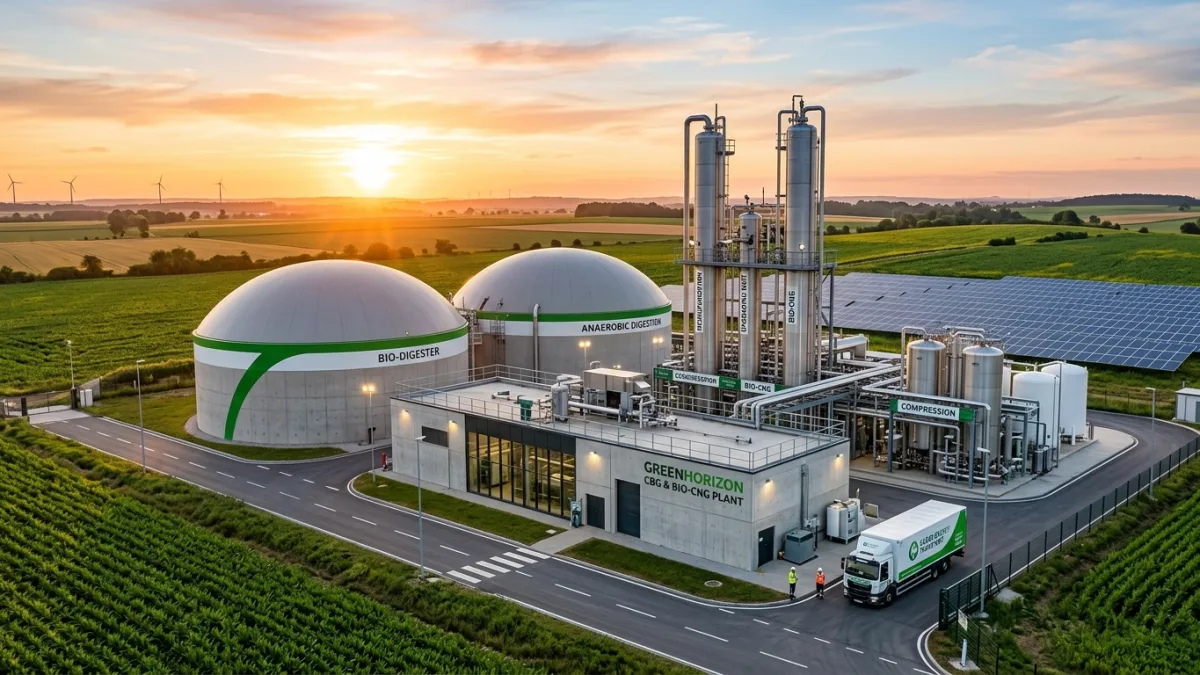
Setting up an industrial Compressed Biogas (CBG) facility in India is a multi-disciplinary infrastructure undertaking spanning biochemical engineering, mechanical and civil construction, regulatory approvals, and fuel distribution logistics. A standard 5 TPD to 10 TPD commercial facility typically requires between 12 and 18 months from initial land acquisition to commercial gas flaring and cascade sales.
As the specialized bio-energy execution vertical of AMVATS ENGINEERING & TECHNOLOGIES, Amvats CBG provides end-to-end Turnkey EPC (Engineering, Procurement, Construction) and PMC (Project Management Consultancy) execution across Bihar and India.
The 6-Phase Industrial Implementation Roadmap
Phase 1: Project Conceptualization & DPR Formulation (Months 1–2)
- Biomass resource survey within 25–40 km of proposed sites.
- Proximate/ultimate substrate testing and mass-energy balance calculations.
- Preparation of Bankable Detailed Project Report (DPR).
- Submission of Expression of Interest (EOI) under the SATAT initiative to secure a Letter of Intent (LOI) from Oil Marketing Companies (IOCL, BPCL, HPCL, GAIL).
Phase 2: Land Acquisition & Statutory Approvals (Months 2–5)
- Acquisition of 4 to 8 acres of industrial or non-agricultural land with clear road access for heavy transport.
- Obtaining Consent to Establish (CTE) from State Pollution Control Board.
- Change of Land Use (CLU) approval and local Gram Panchayat/District Magistrate NOCs.
- Grid connectivity sanction and industrial water allocation clearances.
Phase 3: Financial Closure & Government Subsidy Filing (Months 4–7)
- Debt sanction from scheduled commercial banks or IREDA under priority sector lending.
- Registration on the national unified portal for MNRE Central Financial Assistance (CFA).
- Structuring long-term EPC and equipment supply contracts.
Phase 4: Civil Engineering & Structural Construction (Months 6–12)
- Biomass storage yards, covered sheds, and drainage networks.
- Deep foundation works for heavy Continuous Stirred-Tank Digesters (CSTR).
- Construction of feedstock preparation pits, pre-digester tanks, and pumping stations.
- Digestate handling lagoons, decanter centrifuges, and FOM drying yards.
Phase 5: Mechanical & Electrical Equipment Erection (Months 10–14)
- Erection of insulated digester tanks with double-membrane gas holders.
- Installation of raw biogas conditioning trains, biological desulfurization, and chiller units.
- Integration of high-precision polymeric membrane gas upgrading skids.
- High-pressure 250-bar gas compressors, cascade filling manifolds, and PLC/SCADA automation panels.
Phase 6: Commissioning, Biological Seeding & PESO Sign-off (Months 14–16)
- Final inspection and operational licensing by the Petroleum and Explosives Safety Organisation (PESO).
- Biological inoculant seeding using active anaerobic digestate or ruminant cattle manure.
- Gradual substrate ramp-up monitoring volatile fatty acid (VFA) to alkalinity ratios.
- Achieving vehicular-grade >96% methane purity and commercial cascade dispatch.
| Project Milestone | Target Timeline | Critical Deliverables |
|---|---|---|
| Pre-Development | Month 1 – 3 | DPR, LOI from OMC, land selection, geotechnical survey |
| Permitting & Clearances | Month 3 – 6 | CTE, CLU, PESO layout prior-approval, grid sanction |
| Civil Infrastructure | Month 6 – 11 | Digester plinths, roads, weighbridge, admin building, ponds |
| Equipment Installation | Month 9 – 13 | CSTR tanks, agitators, membrane skid, 250-bar compressor |
| Testing & Inoculation | Month 13 – 15 | Hydrostatic testing, microbial seeding, methane ramp-up |
| Commercial Operations (COD) | Month 15 – 16 | Final CTO, PESO license, OMC fuel dispatch commencement |
Execute Your CBG Plant with Amvats CBG
From regulatory clearances and civil design to turnkey commissioning, Amvats CBG provides end-to-end execution support for commercial Bio-CNG projects.