
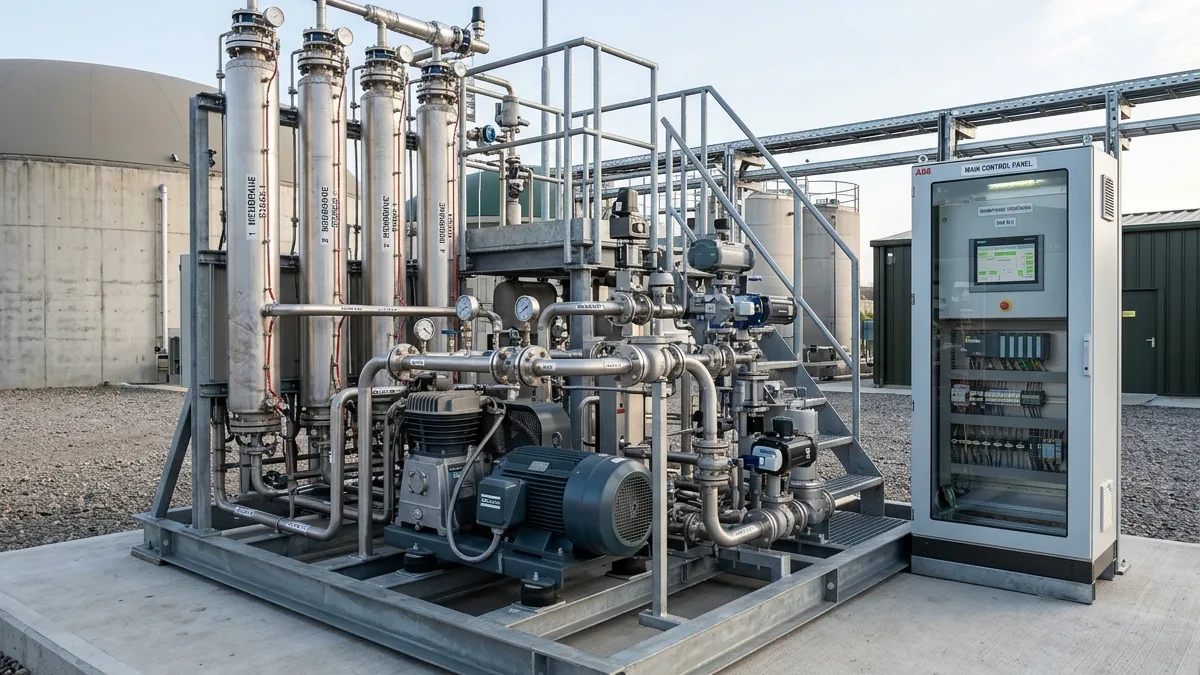
An industrial Compressed Biogas (CBG) facility is a complex chemical process plant engineered to operate reliably 24 hours a day, 365 days a year. Every component—from raw biomass macerators and biological digesters to membrane separation skids and four-stage reciprocating compressors—must function in precise synergy. Specifying the wrong equipment specifications or cutting corners on materials of construction leads to premature machinery degradation, gas leakage, and severe downtime.
As the specialized bio-energy engineering vertical under AMVATS ENGINEERING & TECHNOLOGIES, Amvats CBG designs and deploys high-performance CBG plant equipment packages engineered for maximum uptime and superior operational longevity.
1. Feedstock Pre-Treatment & Feeding Systems
Pre-treatment conditions heterogeneous raw biomass into an easily digestible, pumpable substrate:
- High-Torque Shredders & Hammer Mills: Reduce agricultural stalks and fibrous residues to <5mm particle lengths.
- Hydrocyclones & Sand Separators: Extract abrasive sand, stones, and heavy particles using centrifugal separation, preventing digester silting.
- Submersible Chopper Pumps & Progressive Cavity Pumps: Heavy-duty positive displacement pumps equipped with hardened cutting rings designed to transfer high-viscosity slurries without clogging.
2. Anaerobic Digestion Vessels (CSTR)
The biological core of the plant where anaerobic microorganisms digest volatile solids:
- Tank Construction: Welded glass-fused-to-steel (GFS) or epoxy-coated reinforced cement concrete (RCC) engineered for high chemical and corrosion resistance.
- Agitation Mechanisms: Low-speed central vertical agitators or side-entry multi-speed mixers that ensure complete slurry homogenization, eliminate temperature stratifications, and prevent crust formation.
- Thermal Regulation: External plate heat exchangers or integrated digester wall heating coils maintaining strict mesophilic (37°C–40°C) or thermophilic (52°C–55°C) environments.
- Double Membrane Gas Holders: Flexible biogas storage roofs made of UV-stabilized, flame-retardant PVC-coated polyester fabric, balancing internal gas pressure fluctuations.
3. Biogas Conditioning & Desulfurization
Raw biogas exiting the digester is saturated with water vapor and contains corrosive hydrogen sulfide ($H_2S$):
- Biological Desulfurization (BDS): Microaerophilic sulfur-oxidizing bacteria cultivated on structured media beds convert $H_2S$ into elemental sulfur, stripping up to 95% of sulfur compounds cost-effectively.
- Dry Chemical Adsorption: Secondary iron sponge or activated carbon filters polishing residual $H_2S$ down to <5 ppm.
- Biogas Dehumidifiers / Chillers: Condensing moisture down to dew points < -40°C using refrigerant chillers, protecting sensitive downstream membranes from liquid water blinding.
4. Biogas Upgrading (Enrichment) Skid
Separating carbon dioxide ($CO_2$) to concentrate methane ($CH_4$) to >96% vehicular purity:
- Polymeric Membrane Separation: High-performance hollow-fiber polymeric membranes utilizing differential gas permeation rates. Small, fast molecules ($CO_2, H_2O$) permeate rapidly across the polymer wall, while larger, slow molecules ($CH_4$) remain in the high-pressure retentate stream.
- Methane Recovery: Three-stage membrane configurations achieve methane recovery rates exceeding 98.5% with <1.5% slip into the exhaust stream.
5. High-Pressure Compression & Cascade Dispensing
Prepares purified Bio-CNG for storage and mobile transport:
- Four-Stage Reciprocating Compressors: Heavy-duty non-lubricated or semi-lubricated gas compressors elevating CBG pressure from 8–10 bar to 250 bar (3,600 psi).
- Priority Dispensing Panels: Automated sequencing manifolds distributing gas efficiently across high, medium, and low banks of mobile tube trailers (cascades).
- SCADA / Telemetry Systems: Automated PLC controls with real-time continuous gas chromatographs (CGC) monitoring methane, oxygen, moisture, and $H_2S$ compliance in real-time.
| System Module | Standard Specifications | Safety & Compliance Standards |
|---|---|---|
| CSTR Digester Tanks | GFS / RCC, Mesophilic 38°C ± 1°C | Pressure/vacuum relief valves, anti-static grounding |
| Desulfurization Unit | Biological Trickling + Activated Carbon Polish | ATEX Zone 1 explosion-proof motors, $H_2S$ sensors |
| Gas Upgrading Skid | 3-Stage Hollow Fiber Polymeric Membranes | IS 16087:2016 vehicular biomethane compliance |
| Gas Compressor | 4-Stage Water-Cooled, 250 Bar, 500–1,200 Nm³/hr | PESO approved, flameproof electrical enclosures (Ex-d) |
| Digestate Dewatering | Decanter Centrifuges / Multi-Disc Screw Presses | IP55 washdown motors, stainless steel wetted parts |
Engineered Equipment Solutions by Amvats CBG
Amvats CBG specifies, integrates, and commissions world-class biogas machinery engineered for the demanding realities of Indian biomass and climatic operating conditions.