
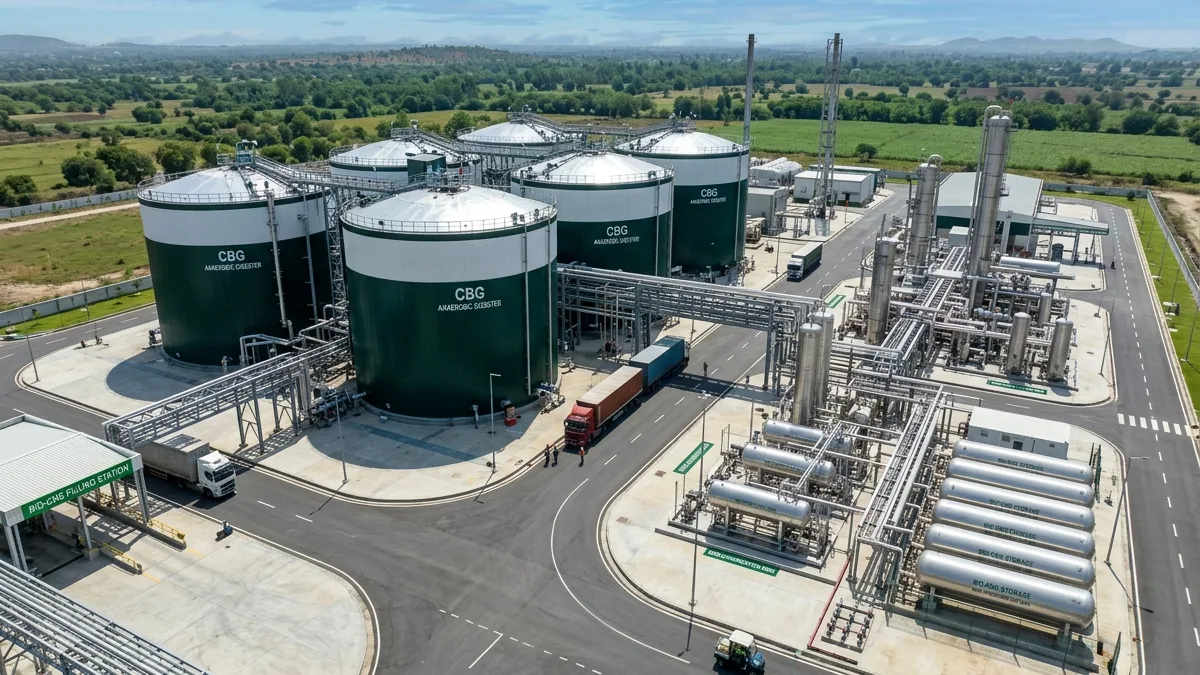
Compressed Biogas (CBG) is an identical, renewable drop-in replacement for fossil Compressed Natural Gas (CNG). However, unlike fossil gas extracted from underground geological reserves, CBG is manufactured through modern bio-refining processes that convert agro-waste, cattle manure, and organic residues into purified biomethane. Understanding the engineering journey of each cubic meter of gas illuminates the precision required to produce high-calorific vehicular fuel compliant with national standards.
Operating as the specialized clean energy vertical of AMVATS ENGINEERING & TECHNOLOGIES, Amvats CBG designs, constructs, and operates closed-loop CBG manufacturing systems that maximize methane capture and minimize environmental footprints.
The 5 Stages of the CBG Production Lifecycle
Stage 1: Feedstock Reception, Sizing and Conditioning
Biomass enters the plant via an automated weighbridge. The processing train begins with mechanical preparation:
- Mechanical Sizing: Agricultural residues (paddy straw, maize silage) pass through heavy-duty industrial shredders to reduce fiber length to <5mm.
- Desanding & De-stoning: Slurries pass through cyclonic grit separators where dense silica particles are centrifugally eliminated to protect downstream pumps.
- Homogenization: In equalizing mixing pits, solid biomass is blended with recycled liquid digestate to achieve a pumpable total solids (TS) concentration between 10% and 12%.
Stage 2: Four-Phase Anaerobic Biomethanation
The conditioned organic slurry is pumped into airtight Continuous Stirred-Tank Digesters (CSTR). Inside the oxygen-free vessel, a syntrophic community of microorganisms digests organic compounds across four distinct biochemical phases:
- Hydrolysis: Extracellular bacterial enzymes break down insoluble complex polymers (cellulose, starch, proteins) into simple soluble sugars, amino acids, and fatty acids.
- Acidogenesis: Fermentative bacteria convert soluble monomers into volatile fatty acids (VFAs), lactic acid, and alcohols, generating small amounts of $CO_2$ and $H_2$.
- Acetogenesis: Acetogenic bacteria metabolize VFAs into acetic acid ($CH_3COOH$), carbon dioxide, and hydrogen gas.
- Methanogenesis: Methanogenic archaea perform the final metabolic conversion, producing methane ($CH_4$) and carbon dioxide ($CO_2$).
Stage 3: Raw Biogas Extraction and Pre-Conditioning
Raw biogas collected in the digester headspace consists of 55%–62% methane, 38%–45% carbon dioxide, water vapor, and 500–4,000 ppm of corrosive hydrogen sulfide ($H_2S$). Before upgrading, the gas undergoes pre-conditioning:
- Desulfurization: Gas passes through biological trickling filters and dry activated carbon beds to reduce $H_2S$ below 5 ppm, preventing sulfuric acid corrosion.
- Chilling and Moisture Separation: Gas chillers cool the biogas to 4°C, condensing water vapor out of the stream to achieve a dry gas dew point.
- Particulate Filtration: High-efficiency coalescing filters remove microscopic oil droplets and aerosols down to 0.1 microns.
Stage 4: Gas Upgrading (Methane Purification)
The pre-conditioned gas is pressurized to 8–12 bar and fed into three-stage polymeric membrane separation modules. Carbon dioxide molecules permeate through the polymeric matrix significantly faster than methane molecules. The retentate stream exiting the membranes contains purified biomethane (>96% $CH_4$, <3% $CO_2$, <0.5% $O_2$), fully meeting Indian Standard IS 16087:2016 for automotive and industrial utilization.
Stage 5: High-Pressure Compression and Cascade Dispatch
The purified CBG is compressed to 250 bar (3,600 psi) by a multi-stage reciprocating compressor. The pressurized gas flows through an automated priority dispensing panel into mobile tube trailers (cascades), which transport the fuel to retail fuel stations or City Gas Distribution (CGD) injection daughter stations.
| Process Stage | Inflow Characteristics | Outflow Characteristics | Energy & Quality Metric |
|---|---|---|---|
| 1. Slurry Preparation | Raw biomass + water | 10–12% TS Homogeneous slurry | Particle size <5mm, sand-free |
| 2. CSTR Digestion | Volatile solids slurry | Raw biogas + digestate | 55%–60% CH₄, 37°C mesophilic |
| 3. Gas Conditioning | Wet raw biogas with H₂S | Dry, desulfurized biogas | H₂S <5 ppm, dew point <4°C |
| 4. Membrane Upgrading | Conditioned biogas @ 10 bar | Vehicular biomethane @ 9.5 bar | CH₄ >96%, CO₂ <3%, IS 16087 |
| 5. 250 Bar Compression | Purified CBG @ 9.5 bar | Dispensed CBG @ 250 bar | Energy density ~52 MJ/kg |
Engineered CBG Solutions from Concept to Fuel
Amvats CBG provides end-to-end process design, technology integration, and plant operations for commercial biomethane projects across Bihar and India.