
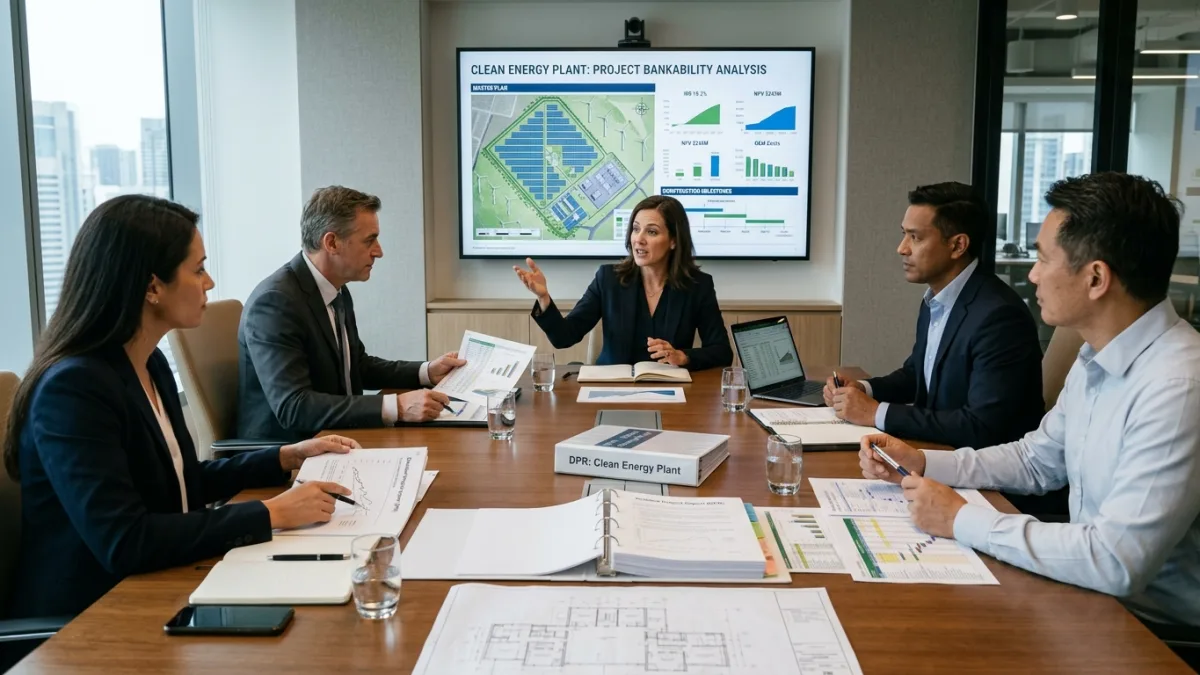
Investing in a commercial Compressed Biogas (CBG) facility in India represents a high-potential capital deployment under the national SATAT initiative and green energy transition. However, successful project execution hinges on a thorough, bankable Techno-Economic Feasibility Study (TEFS) and Detailed Project Report (DPR). Without rigorous pre-feasibility modeling of regional feedstock security, gas offtake logistics, and digestate monetization, projects face severe operational bottlenecks and financial distress.
As the specialized engineering vertical under AMVATS ENGINEERING & TECHNOLOGIES, Amvats CBG prepares rigorous, bank-vetted DPRs and technical feasibility models that satisfy Indian non-banking financial institutions, scheduled commercial banks (IREDA, SBI, PNB), and equity investors.
Core Pillars of a Comprehensive CBG Feasibility Study
A bankable feasibility assessment investigates five interdependent operational and commercial dimensions:
1. Biomass Feedstock Mapping & Catchment Security
Feedstock availability dictates plant sizing and long-term operating risk. The study must verify:
- Catchment Radius: Mapping agricultural residues, agro-industrial waste, and cattle manure within a 25–40 km economic hauling radius.
- Seasonal Fluctuation: Quantifying crop harvest calendars, monsoon access limitations, and storage bunker requirements.
- Laboratory Proximate & Ultimate Analysis: Laboratory testing for Total Solids (TS), Volatile Solids (VS), Biochemical Methane Potential (BMP), and Carbon-to-Nitrogen (C:N) ratio.
- Price Elasticity & Long-term Agreements: Structuring multi-year tripartite feedstock supply agreements with farmers, FPOs, and agro-processors.
2. Site Selection & Geotechnical Suitability
Selecting the optimal site minimizes construction CAPEX and regulatory delays:
- Proximity to Offtake: Logistics access to City Gas Distribution (CGD) injection points or commercial retail fuel cascades.
- Utilities Access: Stable three-phase industrial electrical power (or captive biopower design) and abundant raw water supply.
- Topography & Soil Bearing Capacity: Soil mechanics testing to support massive continuous stirred-tank digester (CSTR) loads (often >10,000 tons wet weight).
- Zoning & Environmental Setbacks: Compliance with state pollution control board (SPCB) siting criteria and residential buffer distances.
3. Financial Modeling, CAPEX/OPEX & Sensitivity Analysis
Financial viability requires realistic financial engineering:
| Financial Metric | Typical Range (5 TPD Plant) | Key Sensitivity Drivers |
|---|---|---|
| Total Project CAPEX | ₹25 – 35 Crores | Digester engineering, membrane vs PSA technology, cascade logistics |
| Equity / Debt Ratio | 30% Equity / 70% Debt | Bank sanction conditions, promoter track record, IREDA guidelines |
| Project IRR | 18% – 24% | Feedstock procurement pricing, OMC base purchase price, FOM sales |
| Debt Service Coverage Ratio (DSCR) | 1.4x – 1.8x | Plant operational uptime (target >330 days/year), gas yields |
| Payback Period | 4.5 – 6.0 Years | Offtake volume stability, Fermented Organic Manure (FOM) pricing |
4. Regulatory Approvals and Statutory Clearances
A bankable DPR outlines the detailed road map for 20+ statutory approvals across central, state, and district levels:
- Consent to Establish (CTE) & Consent to Operate (CTO): From the State Pollution Control Board (SPCB/BSPCB in Bihar).
- PESO Approval: Petroleum and Explosives Safety Organisation clearance for high-pressure gas storage and 250-bar cascade filling.
- MNRE / SATAT Registration: Project enrollment with the Ministry of New and Renewable Energy for Central Financial Assistance (CFA) capital subsidies.
- CLU (Change of Land Use): Agricultural to industrial conversion clearance through district revenue authorities.
- Fire & Factory Inspectorate Licenses: Fire safety NOC and industrial machinery layout approvals.
Why Generic Feasibility Reports Fail
Many prospective CBG developers encounter severe setbacks because their initial feasibility study relied on generic assumptions rather than empirically tested local conditions:
- Overestimating Raw Gas Yield: Assuming laboratory BMP yields without accounting for seasonal feedstock degradation during storage.
- Ignoring Digestate Management: Treating digestate as an afterthought rather than designing integrated solid-liquid dewatering and FCO-compliant marketing networks.
- Underestimating Sand & Grit Abrasion: Failing to budget for heavy-duty de-sanding cyclonic systems, resulting in premature digester silting and equipment overhaul.
Commission a Bankable CBG Feasibility Study
Amvats CBG conducts comprehensive techno-economic feasibility studies, biomass catchment surveys, and bankable Detailed Project Reports (DPRs) for projects across Bihar and India.