
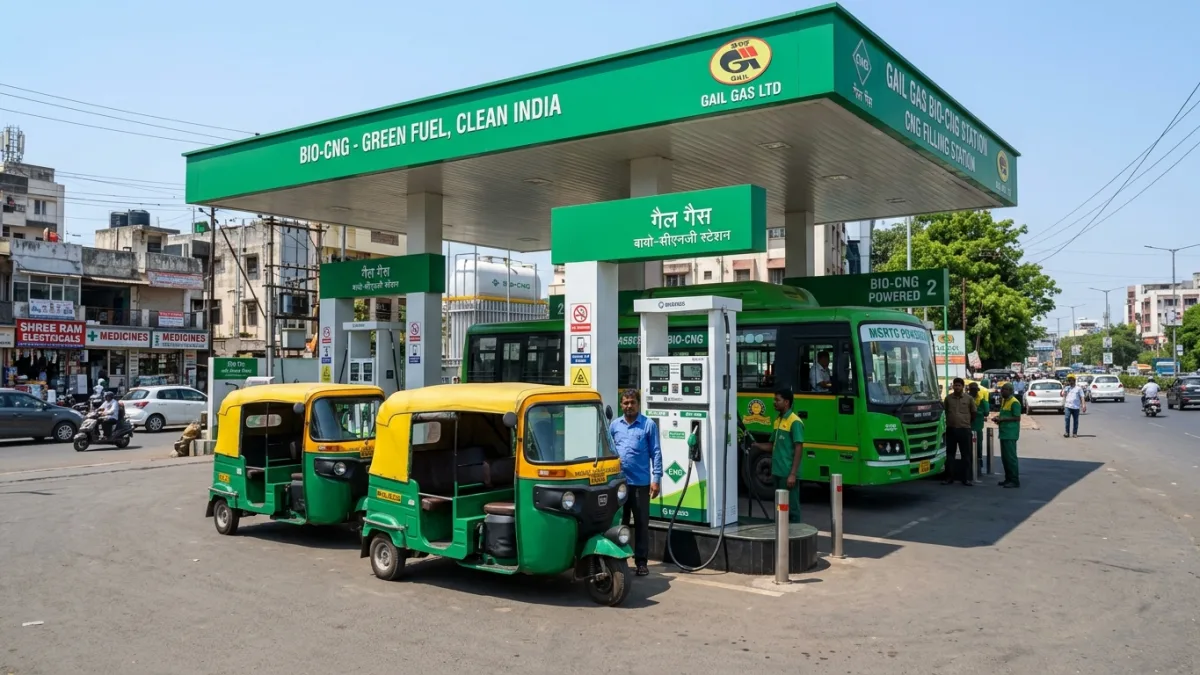
While Compressed Biogas (CBG) and Compressed Natural Gas (CNG) share virtually identical chemical compositions and burn with equivalent calorific performance, their origins, lifecycle emissions, and long-term economic footprints are fundamentally distinct.
1. Origin & Raw Material Differences
The primary distinction between CBG and fossil CNG lies in their sourcing:
- Compressed Natural Gas (CNG): Extracted from underground geological reservoirs through deep fossil fuel drilling. It is an exhaustible hydrocarbon resource that has formed over millions of years under tectonic pressure.
- Compressed Biogas (CBG): Produced above ground via anaerobic digestion of renewable organic feedstocks—such as cattle dung, agricultural crop residues (paddy straw), sugar mill press mud, and segregated municipal organic waste.
2. Comprehensive Comparison Matrix: CBG vs CNG
| Parameter | Compressed Biogas (CBG) | Compressed Natural Gas (CNG) |
|---|---|---|
| Primary Source | Renewable organic biomass & agricultural residues | Subterranean geological fossil reservoirs |
| Methane (CH4) Concentration | ≥ 90% (Typically 92% – 96% after membrane scrubbing) | 85% – 95% (Varies by geological field) |
| Carbon Dioxide (CO2) Content | ≤ 4% (Standard IS 16087 compliant) | 1% – 3% |
| Gross Calorific Value (GCV) | ~ 52,000 kJ/kg (≥ 48,000 kJ/kg under BIS norms) | ~ 48,000 – 52,000 kJ/kg |
| Carbon Footprint | Carbon neutral to carbon negative lifecycle | Fossil emission source upon combustion |
| Vehicular Compatibility | 100% drop-in replacement; zero engine modifications required | Standard CNG engine architecture |
| Co-Products | Fermented Organic Manure (FOM) & liquid bio-fertilizer | Zero organic co-products |
3. Engine Performance & Vehicular Interchangeability
Under the Bureau of Indian Standards (BIS standard IS 16087:2016), commercial CBG is refined to automotive-grade quality with methane levels exceeding 90% and hydrogen sulfide (H2S) maintained below 20 ppm. As a result, automotive commercial vehicles, city buses, three-wheelers, and commercial fleets can fuel with CBG with no fuel system modifications.
To learn more about vehicular biomethane refining, see our Biogas Upgradation Solutions.
4. National Policy & SATAT Framework in India
Under the Government of India’s SATAT initiative, commercial CBG plants receive long-term Commercial Offtake Agreements from leading Oil Marketing Companies (IOCL, BPCL, HPCL) at indexed procurement prices. This framework protects developers from international fossil price volatility while supporting rural energy independence.
5. Summary
CBG provides the exact energy output of fossil CNG while eliminating methane emissions from rotting farm waste and providing organic bio-fertilizer for agriculture. For technical consultations on setting up a commercial CBG project, contact our engineering specialists.