
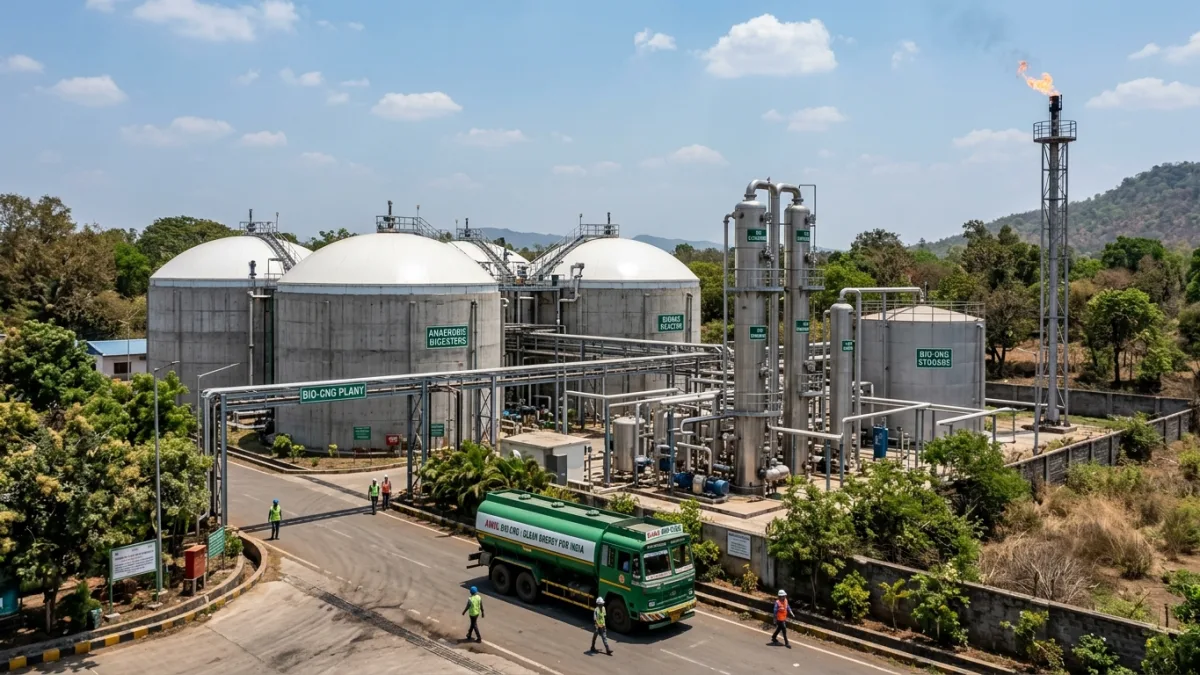
A modern commercial Compressed Biogas (CBG) plant is an integrated bio-refinery that converts heterogeneous organic waste into clean, vehicle-grade biomethane and certified bio-fertilizers. Understanding the inner engineering mechanics of this transformation requires examining the six systematic stages of plant operations.
Amvats CBG operates as a specialized CBG and Bio-CNG business vertical under AMVATS ENGINEERING & TECHNOLOGIES, providing engineering consultancy, process optimization, and comprehensive project execution.
Stage 1: Biomass Reception, Sorting & Pre-Treatment
Feedstocks such as agricultural residues (paddy straw / parali), sugar mill press mud, cattle dung, and municipal food waste arrive at the processing yard. Because microbial digestion requires accessible surface area, feedstocks undergo mechanical conditioning:
- Shredding & De-fibering: Bulky biomass like paddy straw or Napier grass is reduced to uniform particle sizes (10–20 mm).
- Thermal or Enzymatic Blending: Slurry blending balances the dry Total Solids (TS) content and adjusts the Carbon-to-Nitrogen (C:N) ratio to the optimal 25:1 to 30:1 range.
- Contaminant Separation: Inert solids, sand, and heavy grits are removed via hydro-cyclones to protect downstream pumps and digester vessels.
Stage 2: Anaerobic Digestion in CSTR Refineries
The conditioned organic slurry is pumped continuously into sealed, insulated Continuously Stirred Tank Reactors (CSTR). Inside these airtight digesters, specialized consortia of anaerobic microorganisms break down the complex organic matter across four biochemical phases:
- Hydrolysis: Complex polymers (carbohydrates, proteins, lipids) are broken down into soluble monomers.
- Acidogenesis: Monomers are converted into volatile fatty acids (VFAs), alcohols, and carbon dioxide.
- Acetogenesis: VFAs are transformed into acetic acid, hydrogen, and carbon dioxide.
- Methanogenesis: Methanogenic archaea metabolize acetic acid and hydrogen into methane gas (CH4) and CO2.
Explore our deep capabilities in Advanced CBG Technology and anaerobic reactor modeling.
Stage 3: Raw Biogas Collection & Biological Desulfurization
The generated raw biogas accumulates under double-membrane gasholders. Raw biogas contains corrosive hydrogen sulfide (H2S) ranging from 500 ppm to over 5,000 ppm depending on feedstock composition. Before entering precision separation equipment, the gas passes through biological desulfurization units and activated carbon polishing beds to reduce H2S below 10 ppm.
Stage 4: Gas Purification & Upgrading
Once desulfurized and dried of water vapor, the gas enters the upgrading skid. Here, carbon dioxide is separated from methane using modern 3-stage polymeric membrane separation or Vacuum Pressure Swing Adsorption (VPSA):
- Selective Permeability: Polymeric membranes exploit the molecular difference between CO2 and CH4, allowing CO2 to pass through while keeping methane inside the high-pressure stream.
- Ultra-Low Slip: Advanced multi-stage configurations maintain methane recovery rates above 99% with less than 0.5% methane slip.
Learn more about our solutions in Biogas Upgradation & Gas Purification.
Stage 5: High-Pressure Compression (250 Bar) & Dispensing
The upgraded biomethane (>96% CH4) is fed into multi-stage reciprocating gas compressors. The gas is compressed in four stages up to 250 bar pressure and stored in static cascade banks or transferred directly into mobile tube trailers for commercial dispatch to retail fuel stations or CGD pipeline injection skids.
Stage 6: Digestate De-Watering & Organic Fertilizer Upcycling
The digested effluent exiting the CSTR digester passes through heavy-duty decanter centrifuges. Solid fractions are stabilized and aerobically enriched into solid Fermented Organic Manure (FOM), while the liquid fraction (LFOM) is filtered for use as liquid bio-stimulants or recycled to slurry make-up tanks, ensuring zero liquid discharge (ZLD).
Summary
From biomass pre-treatment to high-pressure cascade filling, every phase of a CBG refinery demands rigorous thermodynamic and chemical process design. To evaluate your site feedstock or project feasibility, consult with Amvats CBG today.