
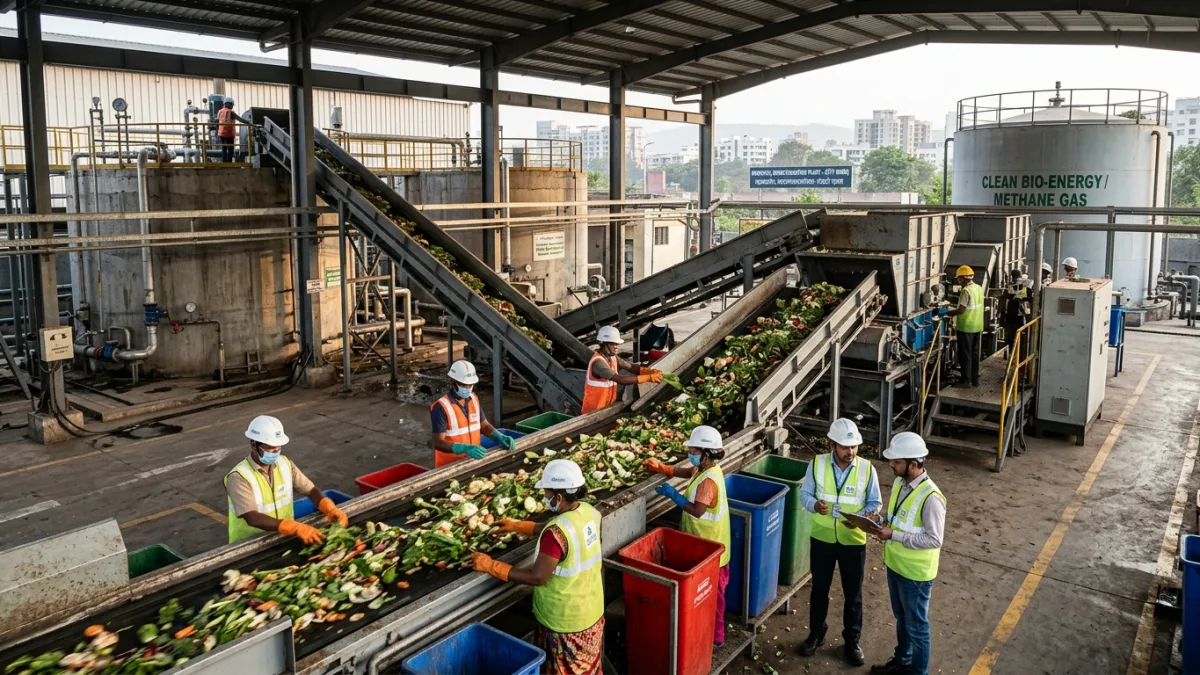
Rapid urbanization and agro-industrial expansion generate millions of metric tons of putrescible organic waste annually. When dumped into open landfills, this waste undergoes uncontrolled decomposition, releasing potent methane ($CH_4$) emissions, contaminating groundwater through toxic leachate, and creating public health hazards. Converting organic waste to Compressed Biogas (CBG) represents the pinnacle of circular economy engineering—converting an environmental liability into clean vehicular fuel and organic bio-fertilizer.
Operating as the specialized green engineering arm of AMVATS ENGINEERING & TECHNOLOGIES, Amvats CBG provides end-to-end municipal and industrial waste-to-energy biomethanation solutions that achieve zero landfill footprint and bankable operational yields.
The Spectrum of Organic Waste Sources
Organic waste suitable for industrial CBG production spans several diverse streams:
- Wholesale Vegetable & Fruit Markets (Mandis): High-moisture, easily biodegradable vegetable and fruit trimmings with low lignin content and rapid methane generation rates.
- Segregated Municipal Organic Waste (OFMSW): Source-segregated wet waste collected from residential wards, hotels, and commercial food establishments.
- Food & Beverage Processing By-products: Starch-rich residues, dairy whey, potato pulp, brewery spent grains, and slaughterhouse organic streams.
- Agro-Processing Residues: Bagasse, press mud, seed husks, and silage waste from regional agro-processing corridors.
Process Architecture: From Waste Collection to Vehicular Fuel
Modern organic waste-to-CBG facilities require sophisticated multi-stage processing trains to ensure biological stability and machinery longevity:
Step 1: Automated Segregation & Depackaging
Even segregated municipal streams contain inorganics like plastics, cutlery, glass, and metal scraps. Advanced facilities utilize automated bio-separators and hammer mills with air classification to screen out inert contaminants, creating a homogeneous, pumpable organic slurry.
Step 2: Hydrothermal Conditioning & Slurry Homogenization
The organic fraction is adjusted for optimal dry matter content (typically 10%–14% TS) in equalizing buffer tanks. Specialized macerators shred fibrous components to sub-8mm particle sizes, maximizing the surface area exposed to bacterial enzymes.
Step 3: High-Efficiency Continuous Stirred-Tank Digestion (CSTR)
Inside sealed, temperature-controlled CSTR digesters, anaerobic consortia decompose complex volatile solids. Digestion occurs in four sequential biochemical stages:
- Hydrolysis: Conversion of insoluble carbohydrates, lipids, and proteins into soluble monomers (glucose, amino acids, fatty acids).
- Acidogenesis: Fermentation of soluble monomers into volatile fatty acids (VFAs), alcohols, and lactic acid.
- Acetogenesis: Oxidation of VFAs into acetic acid, hydrogen ($H_2$), and carbon dioxide ($CO_2$).
- Methanogenesis: Methanogenic archaea convert acetate and hydrogen into methane gas ($CH_4$).
Step 4: Biogas Conditioning & Upgrading
Raw biogas produced from organic waste typically contains 55%–62% methane, 38%–45% carbon dioxide, and 1,500–5,000 ppm of corrosive hydrogen sulfide ($H_2S$). Through biological desulfurization, biological scrubbers, and polymeric membrane gas separation, methane purity is boosted to >96%, matching Indian Standard IS 16087:2016 for vehicular use.
| Waste Substrate | Volatile Solids (% TS) | Biogas Yield (Nm³/Ton Raw) | CBG Yield (Kg/Ton Raw) | Digestion Time (HRT Days) |
|---|---|---|---|---|
| Wholesale Mandi Vegetable Waste | 82% – 88% | 80 – 110 | 38 – 52 | 20 – 25 |
| Mixed Commercial Food Waste | 85% – 92% | 120 – 160 | 55 – 75 | 25 – 30 |
| Segregated OFMSW | 75% – 85% | 90 – 130 | 42 – 62 | 28 – 35 |
| Fruit Pomace / Pulp Waste | 80% – 90% | 95 – 135 | 45 – 65 | 22 – 28 |
Environmental and Economic Dividends
Deploying commercial organic waste biomethanation plants delivers immense multi-dimensional benefits:
- Methane Abatement: Captures fugitive greenhouse gas emissions at the source, preventing atmospheric pollution with a Global Warming Potential (GWP) 28 times greater than $CO_2$.
- Landfill Diversion: Eliminates up to 85% of physical waste volume destined for overburdened municipal dumping grounds.
- Circular Bio-Fertilizer (FOM): Produces nutrient-rich fermented organic manure free from chemical synthetics, enhancing soil organic carbon (SOC) for local farmers.
- Green Revenue Creation: Generates sustained revenue through Bio-CNG offtake under oil marketing company (OMC) purchase agreements and carbon credit monetization.
Turn Municipal and Industrial Waste into Profitable Clean Fuel
Amvats CBG delivers turnkey waste-to-energy project development, from feedstock testing and sorting design to membrane purification and compression cascades.