
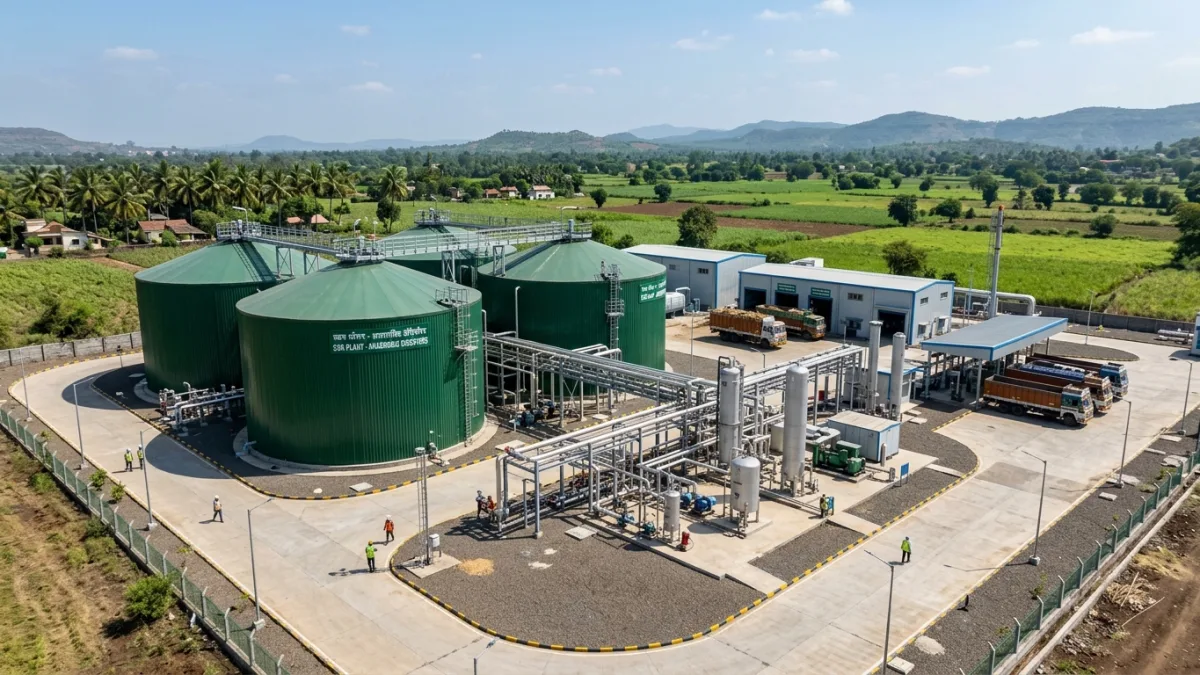
Compressed Biogas (CBG), commonly referred to as commercial Bio-CNG, is an eco-friendly renewable fuel produced through the anaerobic digestion of biomass and organic waste streams. Once raw biogas is scrubbed of impurities and enriched to a methane (CH4) content exceeding 90–96%, it is compressed under 250 bar pressure to serve as a drop-in green substitute for conventional fossil Compressed Natural Gas (CNG).
Amvats CBG is a specialized CBG and Bio-CNG business vertical under AMVATS ENGINEERING & TECHNOLOGIES, dedicated to advancing clean energy, anaerobic digestion technologies, and turnkey project development across India.
1. Understanding the Fundamental Chemistry of CBG
Raw biogas produced from organic decomposition naturally contains roughly 55% to 65% methane (CH4), 35% to 45% carbon dioxide (CO2), and trace impurities such as hydrogen sulfide (H2S), moisture, and siloxanes. In its raw form, biogas cannot be safely injected into vehicular fuel tanks or industrial city gas distribution (CGD) grids due to its low calorific value and corrosive sulfur compounds.
Through advanced biogas upgradation technology, CO2 and contaminants are selectively stripped away. The resulting purified biomethane possesses:
- Methane Purity: Greater than 90% (regularly >96.5% under high-recovery membrane separation)
- Calorific Value: Approximately 52,000 kJ/kg, fully equivalent to standard natural gas
- Bureau of Indian Standards (BIS) Compliance: Governed by IS 16087:2016 vehicular standards
- Zero Engine Modifications Required: Directly compatible with existing CNG vehicles and cascading transport cylinders
2. CBG vs. Conventional Fossil CNG: What is the Difference?
While both CBG and fossil CNG share nearly identical molecular compositions (predominantly methane gas pressurized to 200–250 bar), their origin and ecological impacts diverge significantly:
| Feature | Compressed Biogas (CBG) | Fossil Compressed Natural Gas (CNG) |
|---|---|---|
| Primary Source | Renewable biomass (paddy straw, cow dung, press mud, wet waste) | Underground geological reservoirs (fossil reserves) |
| Carbon Footprint | Carbon-negative or carbon-neutral lifecycle | Net contributor to greenhouse gas emissions |
| Co-Products | High-value Fermented Organic Manure (FOM) | None (extractive fuel only) |
| Domestic Resilience | 100% decentralized local production across India | Heavy reliance on LNG imports and international currency fluctuations |
3. The National Push: India's SATAT Initiative
To curb national crude imports and establish a circular bio-economy, the Ministry of Petroleum and Natural Gas (MoPNG) launched the SATAT (Sustainable Alternative Towards Affordable Transportation) initiative. Under SATAT, public sector Oil Marketing Companies (OMCs) like IOCL, BPCL, and HPCL offer long-term Commercial Commercial Agreements with guaranteed offtake pricing for CBG plants.
Learn more about executing bankable initiatives through our detailed CBG / Bio-CNG Plant EPC and Turnkey EPC Solutions.
4. Valuable Co-Product: Fermented Organic Manure (FOM)
Unlike fossil energy extraction which leaves environmental degradation, every tonne of CBG produced yields substantial quantities of solid Fermented Organic Manure (FOM) and Liquid Fermented Organic Manure (LFOM). These by-products are nutrient-dense bio-fertilizers enriched with organic carbon, nitrogen, phosphorus, and potassium (NPK), revitalizing soil health and replacing chemical fertilizers for local farmers.
Conclusion
Compressed Biogas represents a vital pillar of India's green transition, bridging agricultural waste valorization with clean vehicular mobility. For comprehensive feasibility studies, technological engineering, and project development, connect with our process specialists at Amvats CBG.